THE RIPE STUFF
4 Jul ‘18
SEO For Nonprofits: A Practical Guide to Getting Found Online
4 Jul ‘18
In: Branding & Visual Design, Marketing, Nonprofit Resources, Search Engine Optimization (SEO), Web Design & Development, / By: Ripe Media
Key Takeaways
- SEO helps nonprofits reach donors, volunteers, and program participants who are already searching for what you do
- SEO for nonprofits is different from corporate SEO — it’s built around cause-driven keywords, not product keywords
- Local SEO for nonprofits is especially powerful for serving specific communities
- Content that explains your mission and impact outperforms content that just announces it
- Technical SEO basics — site speed, mobile, schema — matter as much for nonprofits as any other organization

Your next major donor is searching Google right now. So is the volunteer who’s been looking for a cause worth their time. And the family who needs the services your organization provides.
The question is whether they find you, or someone else.
SEO for nonprofits isn’t about gaming algorithms. It’s about making sure that when people search for the causes, services, and communities you serve, your organization shows up. For mission-driven organizations operating with lean budgets and high stakes, that kind of visibility isn’t a luxury. It’s essential.
This guide covers what actually works — from keyword strategy to local search to the technical basics — so your organization can start building the online presence it deserves.
Why SEO for Nonprofits Is Different
Corporate SEO is built around product keywords and purchase intent. Nonprofit SEO is built around something more complex: cause awareness, community need, and donor motivation.
Your audiences aren’t looking for a product. They’re looking for:
- Organizations addressing a cause they care about
- Local services they or someone they know needs
- Ways to get involved, volunteer, or donate
- Proof that an organization is credible and effective
That means your keyword strategy, your content, and your calls to action all need to reflect those motivations — not a sales funnel.
Start With the Right Keywords
Most nonprofit websites are optimized around their organization’s name and internal terminology. That’s a mistake. Your potential supporters don’t know your name yet, they’re searching for the cause.
Think about the difference between:
- “Wildwoods LA” (brand search — only people who already know you)
- “outdoor programs for youth Los Angeles” (cause search; people who need what you do)
The second search is where SEO for nonprofits wins you new supporters. Building content around cause-driven, community-specific keywords is how you get in front of people before they know your organization exists.
Where to start:
Research the search terms your target audiences actually use. Think about the populations you serve, the geographic areas you operate in, and the problems your programs address. Tools like Google Search Console (free) will show you what terms are already bringing people to your site, and where the gaps are.
Local SEO for Nonprofits Is Your Best Friend
Most nonprofits serve specific communities. That geographic focus is actually an SEO advantage. Local search is far less competitive than national search, and the people searching locally are often exactly the audience you need to reach.
Key local SEO for nonprofits moves:
Claim and optimize your Google Business Profile. This is free and affects whether you appear in map results and local packs. Make sure your address, hours, and mission description are complete and current.
Use location-specific keywords throughout your content. “Youth mentorship programs in Boyle Heights” will outperform “youth mentorship programs” for your actual audience every time.
Get listed in local directories. LA County resource guides, nonprofit directories like GuideStar and Charity Navigator, and community organization listings all build local authority and drive referral traffic.
Content That Actually Moves People
Here’s what most nonprofit websites get wrong: they publish content about themselves — their milestones, their financials, their staff — instead of content that speaks to what their audiences are searching for and feeling.
People don’t donate to statistics. They donate to stories and to causes they understand and believe in. Your content needs to do both: answer the search query and connect emotionally.
What works:
- Program explainers: clear, plain-language descriptions of what you do, who you serve, and how to access services. These rank for the cause-driven searches your audiences are running.
- Impact stories: specific, human stories about the difference your work makes. These convert visitors into donors and advocates.
- Resource content: guides, FAQs, and practical information your community actually needs. This builds authority and earns backlinks from other organizations.
- News and updates: grant wins, program launches, events. Signals freshness to Google and keeps supporters engaged.
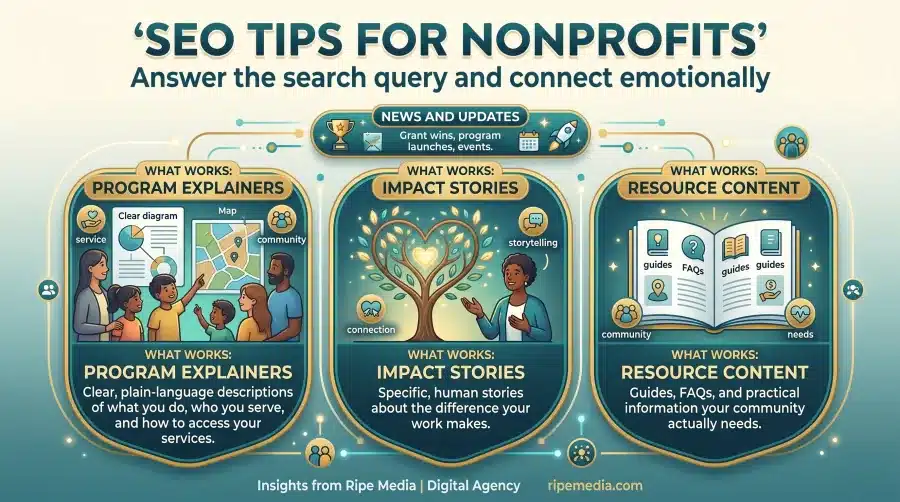
The original version of this article made a point that still holds: messaging that leads with emotional truth outperforms messaging that leads with metrics. Lead with the need, then back it up with the proof.
Technical SEO for Nonprofits Basics You Can’t Skip
Content strategy won’t move the needle if your site has technical problems holding it back. These aren’t optional:
Site speed. Google uses page speed as a ranking signal, and slow sites lose visitors before they’ve read a word. Run your site through Google’s PageSpeed Insights and fix the biggest issues first.
Mobile optimization. A significant portion of nonprofit website traffic comes from mobile devices. If your site isn’t responsive and easy to navigate on a phone, you’re losing both visitors and rankings.
Schema markup. Structured data helps Google understand your content and can earn rich results in search — including FAQ boxes, event listings, and organization information. For nonprofits, Organization and LocalBusiness schema are the most valuable to implement.
HTTPS. If your site still runs on HTTP, that’s an immediate credibility and ranking problem. Fix it.
Don’t Overlook AI Search Visibility
Search behavior is shifting. A growing share of your potential supporters are getting answers from AI tools like Google’s AI Overviews, ChatGPT, and Perplexity, not just clicking blue links. If your content isn’t structured to appear in those results, you’re missing an emerging discovery channel.
The good news: the same practices that make content rank well in traditional search — clear structure, authoritative writing, well-organized FAQs, schema markup — also make content more likely to be cited by AI tools.
For nonprofits specifically, being cited as a resource when someone asks an AI “how can I help unhoused youth in Los Angeles” or “what organizations support veterans in the San Fernando Valley” is an enormous opportunity.
Frequently Asked Questions
Is SEO for nonprofits worth the investment?
Yes — often more so than for larger organizations. Small nonprofits frequently serve niche audiences and geographic communities where search competition is low and a modest SEO investment can produce outsized results. Unlike paid advertising, SEO compounds over time: content you publish today continues driving traffic for years.
How is SEO for nonprofits different from regular SEO?
The mechanics are the same, but the strategy is different. SEO for nonprofits focuses on cause-driven and community-specific keywords rather than product or service keywords. The content is built around donor motivation, volunteer recruitment, and community awareness rather than purchase intent. And metrics like volunteer signups, donation page visits, and program inquiries matter more than e-commerce conversions.
What keywords should a nonprofit target?
Start with the causes you address, the populations you serve, and the geographic areas you operate in. Layer in action-oriented terms (volunteer, donate, apply, get help) and question-based phrases your audiences might search. Avoid internal terminology and acronyms that your potential supporters don’t know yet.
How long does SEO for nonprofits take to show results?
Most organizations see measurable keyword movement within 60–90 days of implementing SEO improvements. Significant traffic growth typically takes 4–6 months. The timeline depends on how competitive your target keywords are and the current state of your site.
Can nonprofits get free SEO help?
Google offers free tools including Search Console and Google Analytics that are essential for any SEO for nonprofits program. Google also offers Google Ad Grants — up to $10,000/month in free search advertising for qualifying nonprofits — which can complement organic SEO efforts. Beyond tools, a managed SEO partner like Ripe Media can handle the ongoing strategy and execution.
Conclusion
SEO is one of the highest-ROI investments a nonprofit can make — because it puts your mission in front of people who are already looking for it.
If you’d like to talk about what an SEO for nonprofits strategy could look like for your organization, contact us for a free consultation. No pressure, no jargon.
You Might Also Like
Related Posts

Share this: